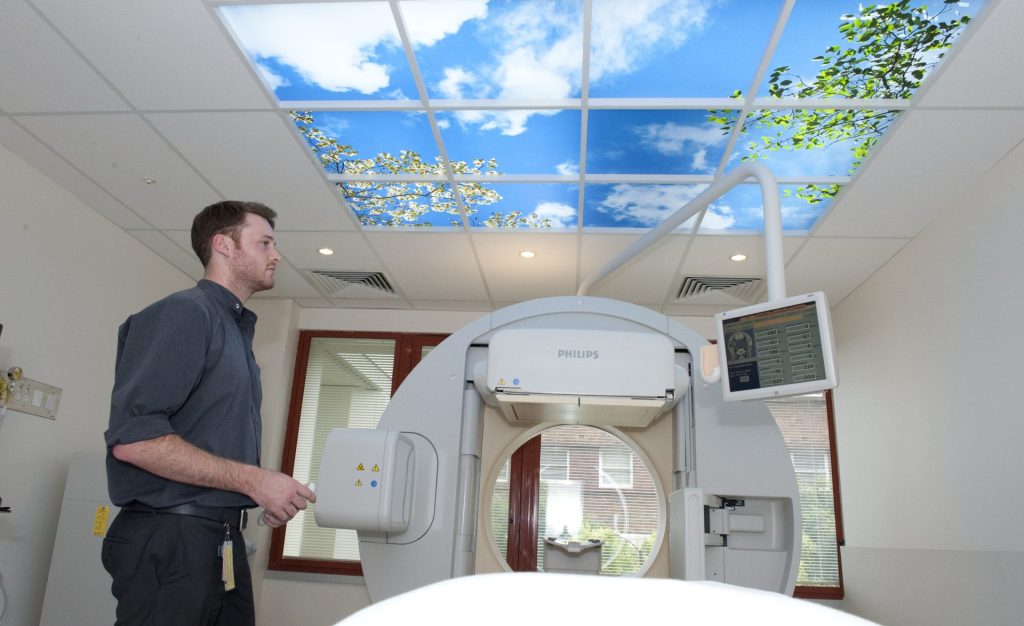
WHAT IS A VQ SCAN?
A Ventilation-Perfusion (VQ) scan is a non-invasive, two-part nuclear medicine imaging scan. The “V” stands for ventilation, or airflow in and out of your lungs. The “Q” stands for quantity of perfusion, or blood flow to the small blood vessels in your lungs. You might also hear it called a lung scan or lung scintigraphy.
A VQ scan is a critical tool for detecting blood clot (s) in your lungs (pulmonary embolism/PE). Which if left untreated, could be fatal.
Less commonly, a VQ scan can also be used to diagnose chronic thromboembolic pulmonary hypertension (CTEPH), which can cause high blood pressure within the vessels of your lungs. Further, a VQ scan can be used before a lobectomy (removal of all or part of your lung) or after a lung transplant to give quantitative/measurable information on lung function.
HOW IS A VQ SCAN PERFORMED?
A nuclear medicine technologist/scientist (NMT/S) performs a VQ scan over two parts, on the same day. The first part (ventilation), you will breathe in a small amount of radioactive gas, then a special camera (SPECT Camera) will take some pictures of the airflow in and out of your lungs. The second part (perfusion) requires the NMT/S giving you an injection of a similar tracer and then taking more pictures, this time of the blood flow in your lungs. The scan, in total, goes for around 30-45minutes. After the images are obtained, they are examined side by side to determine if you have a clot in your lungs or any other lung related complications.
WHAT IS “RISK vs BENEFIT”?
The benefit of obtaining critical diagnostic information to treat diseases such as a lung clot, outweighs the very low, managed risks of radiation exposure.
WHAT ARE THE BENEFITS OF A VQ SCAN?
- Excellent for diagnosing pulmonary embolism (PE).
- Lower radiation exposure than a CTPA.
- Safe for people with low kidney function/ renal failure.
- Safe for people who are allergic to iodine contrast (CT dye).
- Ability to assess and measure lung function.
- Non-invasive and relatively quick scan.
- Minimal discomfort- just a little jab from a needle/cannula.
WHAT ARE THE RISKS OF A VQ SCAN?
- Radiation exposure- which is considered significantly low.
- Very rare hypersensitivity reactions from the injected tracer: This is only seen in people who have a history of reactions to products containing human serum albumin.
IS THIS SCAN SAFE FOR PREGANT AND BREAST-FEEDING WOMEN?
Pulmonary embolism (PE) is amongst one of the leading causes of maternal mortality.
Pregnancy can cause physiological changes within the body, including, pelvic compression, hypercoagulability (increased tendency for blood to form clots) and vascular damage/decreased blood circulation. These changes can increase the risk of PE.
Timely diagnosis and medical management are essential for the welfare of the mother and foetus.
V/Q scans are associated with a small exposure of radiation to the mother and foetus. However, the risk of clots in the lungs or inappropriate/hasty prescription of anticoagulation (blood thinners) outweighs the radiation risk.
Regarding breast feeding women, it is advised for the woman to pump prior to the scan or use formula and withhold from breast feeding for 13hours post scan. During this time, it is advised to pump and discard.
In conclusion, while it is crucial to minimise foetal radiation exposure as much as possible, it is essential to remember that diagnostic studies should not be avoided for fear of radiation exposure, especially when these studies can dramatically change patient management.
Journal articles — References.
https://onlinelibrary.wiley.com/doi/10.1111/1754-9485.13420
https://www.ncbi.nlm.nih.gov/books/NBK551690/
https://www.accessdata.fda.gov/drugsatfda_docs/label/2009/017881s010lbl.pdf